From Raw Fleece to Finished Throw: How Natural Fiber Blankets Are Actually Made
Most people who own a cashmere or alpaca throw have never thought about the number of steps between the animal and their sofa. The finished product — soft, even in weight, consistent in color — gives no visual indication of the process behind it. That consistency isn’t accidental. It’s the result of a production chain where each stage depends on the one before it, and where shortcuts taken early show up as problems later.
Fiber collection and sorting
Cashmere comes from the undercoat of Cashmere goats, combed or sheared once a year during the spring molt. The raw yield per animal is small — typically 100 to 200 grams of usable fiber per goat — which is a large part of why cashmere commands the prices it does. Alpaca fiber comes from the annual shearing of alpacas, with yield per animal considerably higher: a full-grown alpaca produces roughly 2 to 4 kilograms of fiber per year, depending on the breed and the individual animal.
After collection, the raw fiber goes through sorting by hand. This step is slower than it sounds. Each fleece contains a mix of fiber lengths, diameters, and amounts of vegetable matter (grass, seed, debris picked up by the animal). Sorting separates the finest, cleanest fibers — those that will become the softest textiles — from the coarser guard hair and contaminated material. The grade of the finished product is largely determined here.
Scouring and dehairing
Raw fiber is washed — scoured — to remove the lanolin, dirt, and water-soluble impurities that accumulate in the fleece. The wash chemistry matters: water temperature, pH, and mechanical agitation have to be calibrated carefully because natural protein fibers are sensitive to heat and alkali. Wool felts when agitated in hot water; cashmere scales can lock together permanently if the scouring process is too aggressive.
For cashmere specifically, scouring is followed by dehairing — a mechanical separation process that removes the coarser outer guard hair from the fine undercoat fibers. Dehairing is what takes average-grade cashmere and converts it into the kind used in high-end textiles. The industry standard for fine cashmere is a fiber diameter of 16 microns or below; dehairing removes the coarser fibers that would bring that average up. Without it, the resulting yarn feels noticeably coarser against the skin.
Carding and combing
After scouring, the loose, clean fiber goes through carding — a process where the fiber is pulled through rollers set with fine teeth, which opens up the clumps, removes remaining short fibers and debris, and aligns the fibers into a loose web. This web is then drawn into a continuous sliver, a rope-like strand of loosely aligned fiber that feeds the spinning process.
For premium yarns, carding is followed by combing, which removes shorter fibers (called noils) and further parallelizes the remaining long fibers. Combed yarns are smoother, stronger, and more even than carded-only yarns. The choice between carded and worsted (combed) construction affects the final handle of the textile — carded yarns produce a loftier, slightly fuzzier surface; worsted yarns are cleaner and denser.
Spinning
Spinning draws out the sliver and introduces twist, which is what turns loose fiber into a continuous yarn with tensile strength. The amount of twist affects the yarn’s character: more twist produces a harder, stronger yarn; less twist produces a softer, more delicate one. For throw blankets, yarn twist is typically kept lower than for apparel, because the goal is drape and softness rather than abrasion resistance.
Yarn count — the measurement of how fine or coarse the yarn is — determines how many ends will be used in the weaving structure. Finer yarns allow denser, lighter fabrics; coarser yarns produce heavier, chunkier textures. Spinning for luxury textiles often involves plying: twisting two or more spun yarns together in the opposite direction from the original twist, which improves stability and gives the yarn a rounder, more even cross-section.
Dyeing
Dyeing can happen at multiple stages — raw fiber, yarn, or finished fabric — and the choice affects both the visual result and the production logistics. Yarn dyeing (dyeing before weaving) produces the clearest color definition in woven patterns, because each yarn in the structure carries its own color into the weave. Piece dyeing (dyeing the finished woven cloth) is more efficient for solid colors.
Natural fibers accept dye differently. Wool and cashmere are protein fibers that form bonds with acid dyes; cotton and linen are cellulose fibers that require reactive or vat dyes. Getting consistent color across a production run requires careful dye lot control — even small variations in bath temperature, pH, or time produce visible shade differences between blankets that were meant to be identical.
For natural undyed shades — the creams, greys, and browns found in many luxury throws — the fiber’s natural color variation is managed through sorting and blending at the raw fiber stage rather than through chemical dyeing.
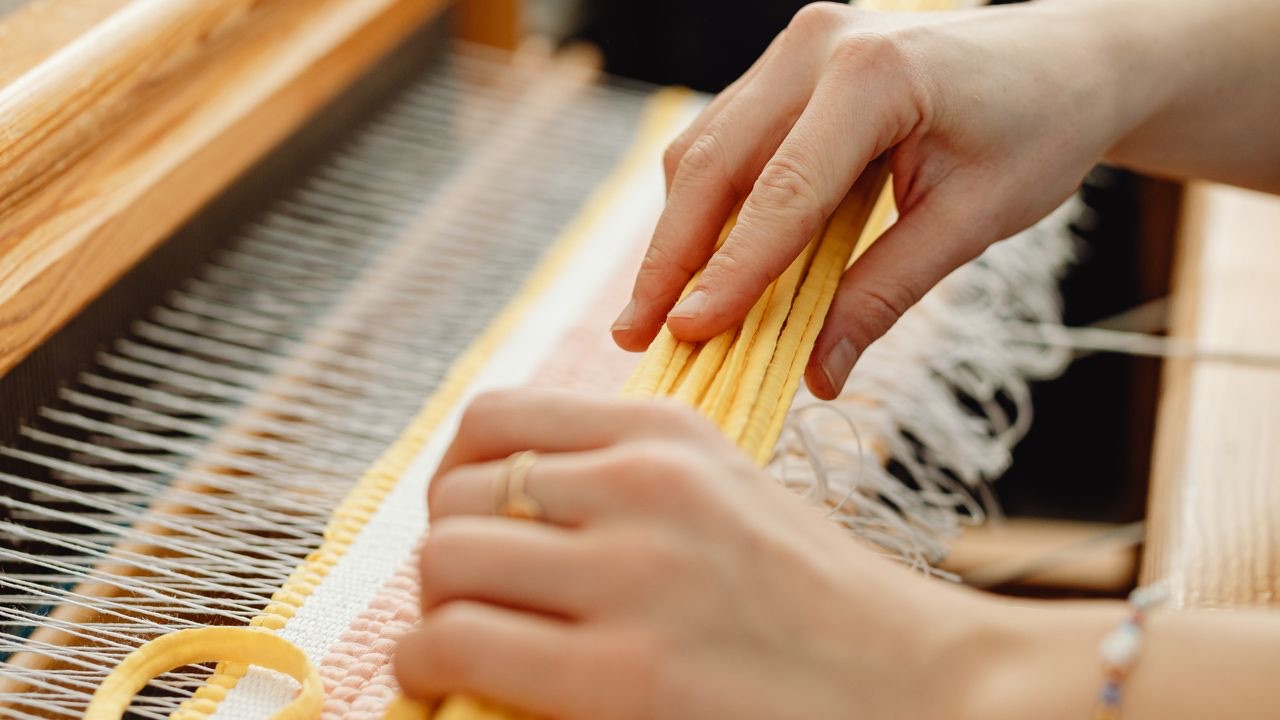
Weaving or knitting
Throws are produced on either looms (woven construction) or knitting machines (knitted construction), and the two create different fabric structures with different properties. Woven fabrics are dimensionally stable — they hold their shape, resist stretching, and are generally more durable for heavy use. Knitted fabrics have more stretch and a softer, more flexible drape.
Within woven construction, the specific weave structure — plain, twill, herringbone, jacquard — determines the surface pattern and the fabric’s density. Jacquard looms can produce complex woven patterns by controlling individual warp threads independently; simpler structures like plain weave and twill use mechanical patterning across the full width.
Finishing
The raw woven or knitted cloth that comes off the machine is not the finished product. Finishing steps change the hand, appearance, and performance of the fabric significantly.
Milling (also called fulling or felting for wool) involves controlled shrinkage through heat, moisture, and mechanical agitation, which locks the fibers together into a denser, more cohesive structure. It’s the step that takes a loosely woven wool cloth and converts it into a fabric with body. The degree of milling is carefully controlled — too little and the fabric feels thin; too much and the weave structure closes up completely.
Raising (or napping) uses rollers set with wire points to lift the fiber surface into a soft pile, which is then sheared to a consistent height. This process creates the characteristic softness and slight fuzz of brushed blankets and throws.
Washing and pressing at the end of finishing sets the final dimensions and appearance of the cloth. The fabric comes out of finishing at a specific width and weight, and the inspection process checks both against specifications before the material moves to cutting and fringing.
Fringing and finishing edges
Most luxury throws end with a fringe, which can be woven as part of the fabric structure or added afterward by hand-knotting yarns into the cut ends. Machine-made fringe is consistent; hand-knotted fringe takes longer but produces a cleaner, more even result that holds up better to washing and use. The length and thickness of the fringe affects the finished proportions of the throw.
What distinguishes a luxury home textiles brand operating at the top of this production chain is control across all of these stages — not just the finished fabric, but the fiber selection, the yarn specification, the finishing protocols. The result that reaches the consumer carries the accumulated decisions of every step in that chain, in a form that isn’t visible but is entirely felt.
Why the production chain matters for buyers
Understanding the production sequence changes what to look for when evaluating a luxury throw. Grade claims (“100% cashmere”) say nothing about fiber diameter, dehairing quality, or yarn construction — all of which affect how the finished textile actually performs. A throw made from lower-grade cashmere that hasn’t been properly dehaired will feel soft initially but will pill heavily with use as the coarser fibers work their way to the surface.
Production transparency — a brand that can speak to where the fiber comes from, how the yarn is constructed, and what finishing processes the cloth goes through — is a more reliable quality signal than the material name alone. The steps that justify a higher price point are often the invisible ones: the dehairing that removed the coarse fibers, the combing that aligned the remaining ones, the controlled milling that gave the fabric its density.
None of this is visible in the finished product. All of it is present in how it feels, how it wears, and whether it’s still worth reaching for five years from now.